
Reaching buyers before they search for you.
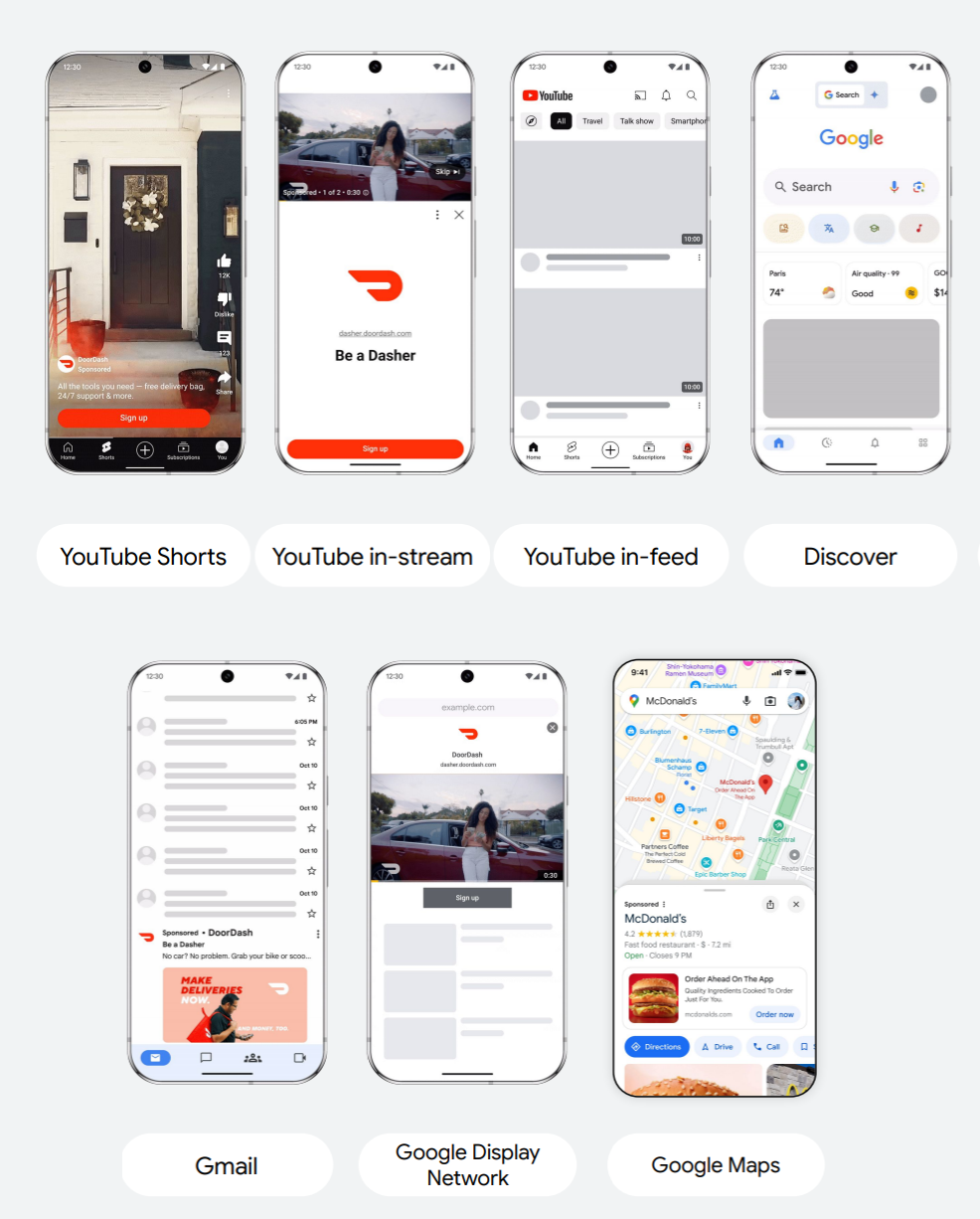
Demand Gen finds and converts people across YouTube, Discover, Gmail, Maps and Display — creating new demand instead of only capturing what already exists. Here's who it suits, how to run it well, where it goes wrong, and how to launch.
Who should consider Demand Gen
Demand Gen is a mid-funnel consideration engine that fuels your bottom-funnel performance. It sits above Search in the funnel: it can optimize toward the same conversions, but its job is to generate brand-new interest rather than harvest it. The clearest distinction from Performance Max is intent — Performance Max captures existing demand; Demand Gen creates it. You also keep real control over inventory and audiences, which PMax doesn't give you.
It's a strong fit if you recognize yourself in any of these:
- You've tapped out Search and PMax and need a profitable, scalable channel to grow volume beyond captured demand.
- You're drowning in unqualified leads from broad-match or PMax and want to optimize toward quality instead.
- You run lead gen or B2B and want to reach people who are researching the problem before they know your category exists.
- You're a brick-and-mortar business — Maps inventory is now generally available for Demand Gen.
- You're in a policy-restricted vertical (housing, healthcare, finance). Some audience types are limited, but contextual targeting is a newer unlock worth testing.
- You tried Demand Gen before and were unimpressed. Gemini now powers relevance and precision across hundreds of backend changes — it's worth a fresh test.
Demand Gen plays across future and existing demand — feeding the bottom-funnel actions that Search closes.
What good looks like
Adopting at least three of the four core best-practice buckets correlates with 40%+ more conversions and 30%+ higher conversion value. Most underperformance traces back to a campaign that was never set up the way the product is designed to run.
Audience
Optimized targeting with first-party data, lookalikes of your converters, and new-customer acquisition seeded from your 1P lists.
Budget & Bid
Around 8% of account spend on Demand Gen, with a daily budget at least 10× your CPA bid on target campaigns.
Creative
Three images in each ratio (or one video per ratio), a vertical video for Shorts, plus account and asset linking enabled.
Data & Measurement
Google tag plus first-party data, or offline imports carrying at least 3 of 6 match identifiers (GCLID, PII, IP, and more).
1. Conversion selection
Optimize toward an online conversion action — not a raw offline import, not a GA4 event. Online actions let the campaign see all three YouTube conversion types: click-through (CTC), engaged-view (EVC) and view-through (VTC). Tons of YouTube conversions are engaged-view: someone watches 10+ seconds, then converts later, directly on your site. Offline conversion import alone misses that entirely, so it under-reports, struggles to ramp, and often can't clear the learning period.
If you rely on offline data, implement Enhanced Conversions for Leads (ECL) so you regain visibility into all three conversion types. Then pick the lowest-funnel conversion you can actually fund — and move deeper as you prove the concept.
tCPA and Max Conversions bidding optimize to CTCs + EVCs in the "Conversions" column.
2. Budget & bid — fund it properly
- Set the initial bid at roughly 2–3× your non-brand Search CPA — Demand Gen sits higher in the funnel, so it isn't meant to match Search one-for-one.
- Aim for about 10 conversions per day to ramp; the learning period is 50 conversions (longer than other campaign types).
- Quick math: bid × 10 ≈ daily budget. If your funded action is too expensive to hit volume, move up the funnel (a form start, asset download, or quality site visit are valid proxies for down-funnel outcomes).
- At the account level, treat ~8% of total spend on Demand Gen as a planning North Star — that's where account-level CPA efficiencies tend to begin (some advertisers see them closer to 12% on a U-curve).
3. Audiences — the single biggest lever
If you take one thing from this guide, take this: audiences are the key lever for Demand Gen quality. Two stand out.
- Custom-intent keywords — Demand Gen's superpower. Google owns YouTube, so you can target the high-intent things people type into Google and YouTube, often at a lower cost than the equivalent Search CPC.
- AI-powered targeting — lookalikes built from high-value seed lists (MQLs, top customers), plus optimized targeting, which expands beyond your set audience to find likely converters (~10% more conversions when your base audience is well honed).
Use Gemini to build custom segments by buyer journey: prompt it as your prospect and ask what they'd search at the discovery, high-intent, and pain-point stages — then turn those phrases into custom-intent audiences. Also mine the audience insights report (Audience Manager → Your data insights) and add audiences in observation mode on Search to find segments worth porting over.
4. Creative — earn attention, then ask
Run across all inventory by default — more placements give the system more ways to hit your goal. Then build creative against the ABCDs:
- Attention — hook within the first 5 seconds; ads are skippable after that.
- Branding — show who you are early and often; keep a logo present throughout, not just the end card.
- Connection — make people feel something; YouTube is for education and entertainment.
- Direction — one clear call to action.
Target ~80% ABCD adherence, keep videos in the 20–60 second range, and lean on how-to and testimonial formats plus lifestyle imagery. Stock the ad with multiple aspect ratios (landscape, square, vertical), 3–5 images and 2–3 videos. Pull inspiration from the Best Ads library, consider Creator Partnership Boost (≈+5% CTR on Shorts), and close gaps with Asset Studio generative tools (image generation, AI editing, image-to-video).
Attention
Hook within the first 5 seconds, keep visuals bright and high-contrast, and bring the action early.
Branding
Show your brand early, often and richly — keep a logo present throughout, not just the end card.
Connection
Make people think or feel something. Humanize the story and pull emotional levers.
Direction
One clear call to action, reinforced with audio and on-screen text.
Asset generation
Create original, high-quality images from text prompts — now able to feature your own product imagery.
AI image editing
Refine up to 100 assets at once — object add/remove, background expansion — powered by Nano Banana Pro.
Image-to-video
Generate 10-second ads with Veo and Nano Banana: upload or create an image, add text and a logo, launch.
Common pitfalls
Most Demand Gen disappointment isn't the product — it's a handful of avoidable setup and expectation errors.
Judging it like Search
Expecting Demand Gen to match non-brand Search CPA one-for-one. It's a higher-funnel tactic — that's why the 2–3× bid guidance exists. Measure its trickle-down into Search and PMax, not just its own column.
Starving the campaign
A $500/day budget bidding toward a conversion that costs $2,000 on Search will never clear the 50-conversion learning period. Underfunding is the most common cause of churn. Fund it, or pick a cheaper proxy action.
Offline import alone
Relying only on offline conversion import hides engaged-view conversions, so the system under-reports and can't ramp. Add Enhanced Conversions for Leads to see all three conversion types.
Calling it too early
The down-funnel effect takes time. Bake in ~8 weeks of testing and don't pull the user-overlap / full-funnel report until the 45–60 day mark. And accept that cross-channel attribution is never perfect.
Skipping best practices
You can't fairly evaluate a campaign that was never built the way the product runs. Audit against the four buckets before drawing conclusions about performance.
Over-restricting placements
Channel controls let you opt out of inventory — but every placement you remove takes away an optimization opportunity. Limit deliberately, not by default.
Treating audiences as an afterthought. Optimized targeting only shines when your base audience is well defined, and lead-gen advertisers often skip custom-intent keywords — the very thing that makes Demand Gen distinct. A loose audience plus a deep conversion goal plus a thin budget is the recipe for "Demand Gen doesn't work for us."
How to launch Demand Gen
A sequence you can run this quarter. Each step de-risks the next.
Audit (or build) the foundations
Check existing campaigns — or your launch plan — against the four best-practice buckets: Audience, Budget & Bid, Creative, Data & Measurement. Aim to satisfy at least three of four. A Google strategist can help run the audit.
Get measurement right first
Use an online conversion action (or Enhanced Conversions for Leads). Choose the lowest-funnel conversion you can fund — drop to a proxy like form start or asset download if needed. Ask your strategist to enable platform-comparable conversions and attributed brand searches so you can see Demand Gen's effect on Search.
Fund the test deliberately
Initial bid ≈ 2–3× non-brand Search CPA; budget for ~10 conversions/day to ramp. Hold ~8% of account spend as the longer-term planning target.
Build robust audiences
Lead with custom-intent keywords and lookalikes from your highest-value lists; layer in optimized targeting. Use a Gemini prompt to map buyer-journey search language into new custom segments, and check the audience insights report for high-indexing in-market/affinity segments.
Stock the creative
Build ABCD-compliant 20–60s video plus multi-ratio imagery. Borrow ideas from the Best Ads library, explore Creator Partnership Boost, and fill gaps fast with Asset Studio.
Measure over 8 weeks, then scale
Short term (0–2 wks): quality site visits, platform-comparable conversions, attributed brand searches. Medium (2–6 wks): assisted + direct conversions. Long term (6–8 wks): account-level CPA, account conversions and user-overlap. Once a single segment proves out, move to a deeper conversion or expand to new loan types / product lines.
- Platform-comparable conversions
- Attributed brand searches
- Optional: Brand Lift study
- Assisted + direct conversions
- Optional: Search Lift study
- Account conversions & blended CPA/ROAS
- Converted-user overlap
What it looks like when it works
Truss Financial Group
Performance Max was flooding the pipeline with unqualified leads. Truss shifted to Demand Gen, built ABCD-driven video, and validated on a single loan type before expanding to two more and doubling remarketing.
Suited Connector
Needing scalable, profitable volume beyond Search and PMax, Suited Connector launched Demand Gen as a high-volume play and tested on its roofing segment — making it their second-best channel after Search.
About this guide. A practical summary of Google's "Advanced Demand Gen Strategies: Lead Gen" session (June 2, 2026) and the accompanying roundtable discussion. Figures — including the 68% non-searcher stat, the 30% Gemini lift, the 8%-spend / 5%-CPA relationship, the 40%+ conversion and 32% revenue figures, and the case-study results — are drawn from Google internal data and third-party studies cited in that material.